itineraire mis-a-jour le 25/12/2011, 26 100 km parcourus

lundi 10 janvier 2011

10/01/11 Fujian

Le 3 janvier 2011 au matin, nous débarquons à Xiamen, une ville complètement remastérisée à l'occidentale avec des boulevards propres et larges, des parcs et des gratte-ciels imposants. En roulant, j'aperçois un chinois au pied d'un hotel de luxe tirant à mains une charrette en bambou remplie de gravier. En cette image s'explique toute la dualité chinoise. Modernité et prospérité d'un côté de la rue, le tiers monde de l'autre.
Après une journée de repos, on décide de quitter Xiamen et de rouler à travers les montagnes du Fujian. Tout le bord de la côte est très industrialisé avec parfois des villes dortoirs possédant d'immenses tours d'habitations. Par contre, dès qu'on va vers le nord, dans les montagnes, on rentre dans un monde rural dans lequel chaque parcelle de terre est cultivée, même si cette parcelle est juchée au sommet d'une montagne. Quelque soit la région traversée, tout le monde fait pousser des pomelos. Imaginez les Appalaches complètement défrichées et terrassées, dédiés en totalité à la monoculture d'un gros agrume à mi-chemin entre un pamplemousse et une orange.
Les villages sont généralement assez rapprochés les uns des autres. Les habitants sont sympathiques et accueillants. Presque chaque fois qu'on s'arrête pour acheter quelque chose, manger ou consulter notre carte, des petits attroupements se créer autour de nous. On s'imagine qu'ils doivent jaser de mes poils et du long nez d'Amélie. Les gens ont également un grand sens de l'hospitalité. On se fait régulièrement inviter à manger et plus souvent qu'autrement, les patrons des restaurants réduisent notre facture ou refusent carrément de nous faire payer.
La Chine en chantier, c'est une tâche colossale à accomplir avec un manque d'expérience, de qualifications et d'équipement combiné à une main-d'oeuvre abondante et bon marché. Ci-dessous, quatre hommes plantant un poteau électrique en béton centimètre par centimètre, à l'aide de cordages et de bâtons en bambou. Une besogne qui peut prendre plusieurs heures.
On se fait régulièrement inviter à prendre le tcha (thé), ici avec des travailleurs de chantier. On boit rapidement en se regardant sans trop se comprendre et en grignotant des prunes confites ou bien des olives amères. Les Fujianais ont vraiment une méthode charmante de servir le thé mais je renonce a essayer de vous la décrire.
On s'engage dans une petite route dans les montagnes censée nous conduire en plein coeur de la civilisation Hakka. La route se transforme rapidement en un chemin de boue puis on roule sur la roche-mère avant de décider de mettre pied à terre et de pousser nos vélos. Plus loin, la route est bloquée parce qu'ils font des travaux de terrassement. On attend une heure puis ils nous laissent finalement passer. Un peu plus loin, la route est de nouveau bloquée suivi d'une attente de 2 heures et on passe. Un peu plus loin, route de nouveau bloquée. 
Finalement, lorsque la noirceur et le froid sont bien installés dans la montagne, ils nous déblaient la route pour une troisième fois et nous laissent passer. On a roulé 30 km, attendu 4 heures en regardant des pelles mécaniques et la prochaine ville est beaucoup trop éloignée pour s'y rendre. De toute façon, on ne peut pas rouler dans la noirceur sur une route de roches et de boue. C'est l'fun la Chine!
En nous voyant marcher avec nos lampes frontales sur le front, une famille de cultivateurs nous invite a manger et à nous reposer chez eux. C'est vraiment la campagne chinoise. Pas d'eau courante, pas de chauffage, pas de toilette mais des gens souriants et aimables. La petite maison cohabite trois générations de chinois emmitouflés dans leurs manteaux, serrés les uns aux autres. On passe une belle soirée avec eux à boire le tcha. Ils nous proposent de dormir au deuxième étage de la maison voisine qui est inhabitée et qu'ils utilisent comme grange. Dans l'une des chambres, il y a un lit comme ceux que l'on retrouve dans les musées et qui étaient autrefois donner en guise de dote au nouveau marié.
Au matin, après un déjeuner copieux, nous retrouvons espoir en roulant sur une route exempte de travaux et tout juste complétée. On roule toute la journée heureux de savoir à peu près à quel endroit nous sommes rendus (hier, nous étions un peu angoissés). En fin de journée, on aboutit sur une route étrangement familière. Nous sommes en fait revenus 5 km en amont d'une intersection prise la veille au matin. Nous qui pensions avoir roule un bon 100 km vers le nord, nous avons plutot fait une belle boucle dans les montagnes. Mais bon, on a vu ce que nous voulions voir dans les montagnes. Retournons a la civilisation maintenant!

dimanche 2 janvier 2011

02/01/11 Taiwanese East and North Coasts

In our travel guide book, it was mentioned many times that the East Coast was isolated from the rest of the island but you really have to go there to actually understand it. The road that links that East Coast from the North has countless tunnels, exhausting climbs and vertiginous downhill stretches in order to force a route through the volcano-like slopes that fall directly into the sea. In those mountains, we saw groups of wild monkeys for the first time.
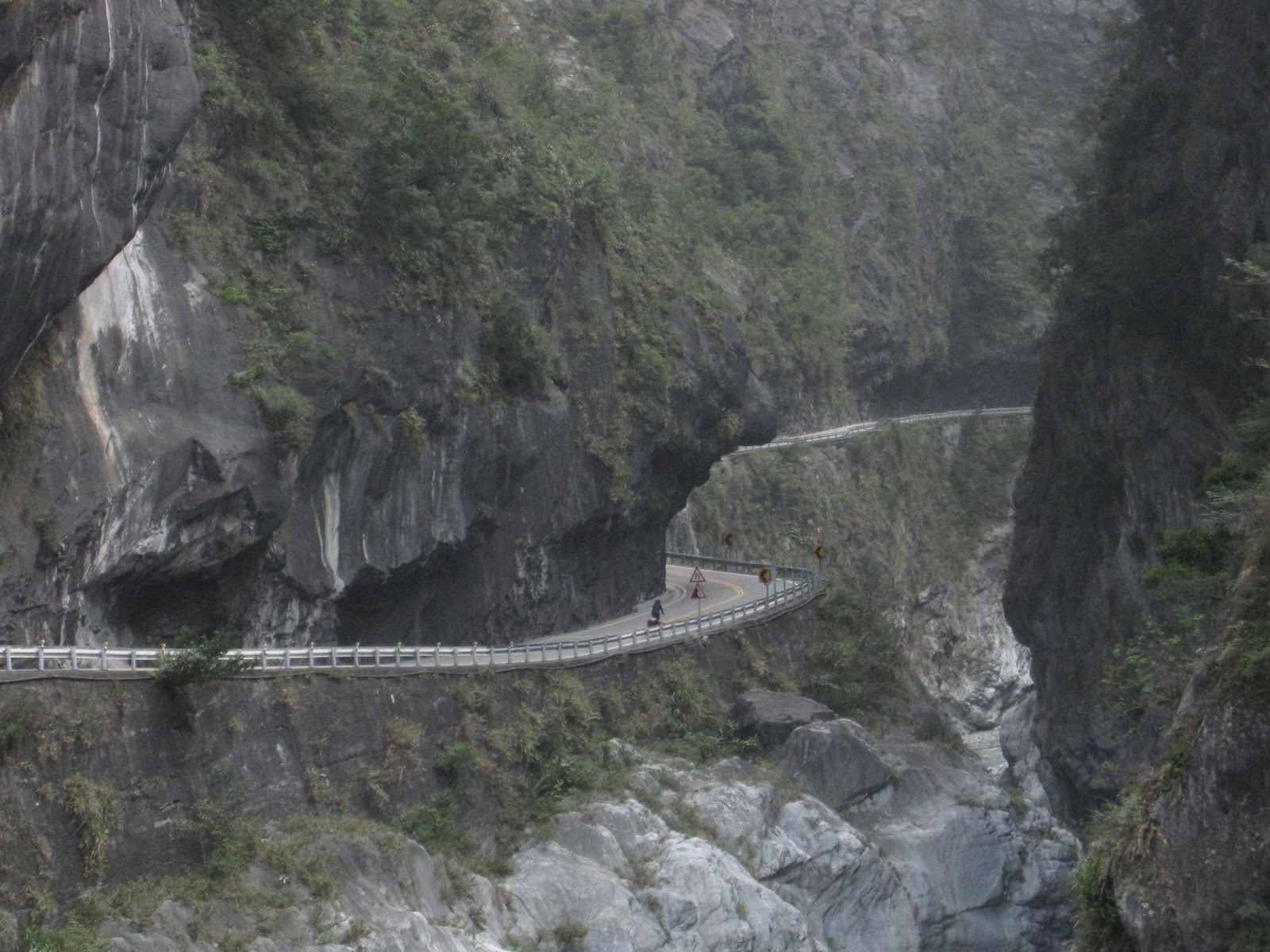
The route is extremely dangerous but worth. The road is single lane with no shoulder and endless dark and dusty tunnels and heavily used by autobus and trucks. It can be scary, particularly when you brake you rear break line in the middle of a downhill session like it happened to me. It is so hardcore that the bike shop at the end of the road gives a sticker that say that you are a real one since who have done this road. Ok ok, it is written in Chinese but that's what the guy told us.
Can you see the road sneaking in the mountains on that picture
Going around this bay on the 31th of December, we just hit the 10,000km done since we left Montreal. What a nice place to celebrate.

Turtle Island, yes, like in Pirates of the Caribbean.

The North Coast is more populated but still have its charm, including excellent seafood dishes.


Typical Taiwanese cemetery
 
A picture of Keelung from the Cosco boat that is bringing us in Xiamen in China. 
To take this boat you have to find someone who can speak mandarin and book the ticket for you by calling the company (see the link).


jeudi 30 décembre 2010

30/12/10 Les Gorges de Taroko

Sur la côte est, outre l'incroyable bord de mer, notre premier véritable point d'intérêt porte sur les Gorges de Taroko près de Hualien. Le soir avant de s'aventurer dans les gorges, on rencontre Chocolate qui nous invite chez elle pour la nuit. L'hospitalité des Taiwanais est vraiment une chose incroyable. On repart le lendemain frais et dispos.

Les Gorges de Taroko sont des formations de marbre à travers lesquelles une rivière a fait son chemin. La route de 20 km qui suit la rivière est très impressionnante, comportant plusieurs tunnels et passages étroits bordés de falaises. Ils recommandent aux visiteurs de porter un casque à cause des risques d'éboulements. Nous, on a déjà des casques...


mercredi 29 décembre 2010

29/12/10 Are we going around Taiwan?

On Christmas day, we leave Shu Zen College and make our way up the central mountains. The road is tiny, steep but the scenery is just gorgeous. Large sections of the road have collapsed and almost every bridge we cross is under construction. Looks like they got a huge catastrophe. Could it be due to one of the several earthquakes that stroke the region recently?


Half way to the top, at about 1500 m high, after two days of biking, we are stopped by a huge construction site. We try to make our way through it but we are told by the locals that the road that crosses the mountains is under heavy constructions and closed for a month. We have no other choice than going back down the mountains. Since the beginning of our trip in Taiwan, people keep asking us if we are biking around Taiwan, which is fairly popular here, and we were saying no since we were planning to take that South Crossing-Highway. But at the end, we won't have any other choice than going South and making it around the island. That's what we call destiny...

Interesting rock formation on our way down. Note the trucks and backhoes working in the river. It is common see those kind of work in Taiwan river's during the dry season.

Taiwan grows an incredible quantity and variety of fruits on the flat lands surrounding the central mountains: bananas, pineapples, papayes, guavas, tomatoes, bell fruits, coco nuts, buddha heads, leeches, pears, prunes, oranges and more.

On that picture, you can see a kind of palm tree who produces bitternuts. Locals chew and spit that nut all day long and get addicted to it. The bad thing about it is that it is highly cancerogen which explains why Taiwan has one of the highest mouth cancer rate in the world. Everywhere you can see men with red, inflated lips and the cancer growing on their cheeks.

vendredi 24 décembre 2010

Shu Zen College

The Shu Zen College gave us a warm welcome. We really felt like home there. Students are curious and are willing to help us learning Chinese and reading the menu at the cafeteria. In order to give back to that community, we decided to do presentations to the students. Most of those students have never go outside of Taiwan so it was a big shock for them to hear that someone could actually bike around the world.


 Students even gave us Christmas gifts including nice letters, chocolates and really good pineapple cakes.

On the 21st of december, Taiwanese celebrate the shortest day in the year by making rice paste balls and baking them in a soup. Traditionally, everybody get one year older on this day instead of having each an individual birthday. That means for example that a baby born on the 20th will have one year already on its second day on Earth.

 Then, we walked through each floor of the dormitory. The students of each floor had decorated their floor and prepared a small performance for us. This is Christmas spirit like we don't see it in Canada.


Tonight is friday and most of the 5000 students have been taking the bus to go back home. On our side, we have decided to leave tomorrow and bike through the mountains and then along the East Coast, spend the new year in Taipei and finally take a boat in Keelung to Xiamen in China.

lundi 20 décembre 2010

20/12/2010 LiouCiou Island

From Kaohsiung, we bike to Donggang which is the only port from where you can go to LiouCiou island.
A performance in the street theater. Looks like a Comedia Del Arte isn't it. 
After getting lost for a good hour in the street and the harbour of Donggang, we finally wfnd the ferry charter and get onbard. The sea is calm and there are fishing boats everywhere. Nice sunset.
Back on earth, after having seafood in a local restaurant, we reach the hotel where we are supposed to camp. There is no real camping spot so we just set our tent in front of the sea on the lawn. We spend the night drink beer and eating fruits confortably sitted on beach long chairs watching the sea.

What makes this island unique is the fact that it is entirely composed of coral. Wooden and stone walks zigzag between coral rocks and sometimes go through dark caves and later exit on the blue sea.

You have to be on this island to realize how steep is Taiwan. From there, the whole Taiwan looks like a single mountain.
Vase Rock, a coral block grinded by the sea to form this shape.
Most of the island shore's are made of rough coral formation that do not allow for swimming but seem to hide many kind of shellfishes.
Byebye Little LiouCiou Island!

50 km of biking later, we are back at Shu Zen College.